3.19. sample_crypto Usage Instructions
3.19.1. Function Overview
sample_crypto demonstrates the usage of common security operation interfaces through multiple operation examples. Below is a description of each example’s functionality:
sample_cipher: Implements symmetric encryption and decryption operations
Supports configuration of encryption algorithms, including AES / DES / SM4
Supports configuration of key sizes: 64 / 128 / 192 / 256 bits
sample_digest: Implements hash digest computation
Supports configuration of hash algorithms, including MD5 / SHA1 / SHA2 / SHA3
sample_hmac: Implements message authentication code (HMAC) computation
Supports configuration of hash algorithms, including MD5 / SHA1 / SHA2 / SHA3
Supports arbitrary key length configuration
sample_rsa: Implements asymmetric encryption and decryption operations
Supports generating RSA key pairs
Supports configuring RSA key length: 1024 / 2048 / 3072 / 4096 / 8192 bits
Uses public key for encryption and private key for decryption
3.19.1.1. Software Architecture Description
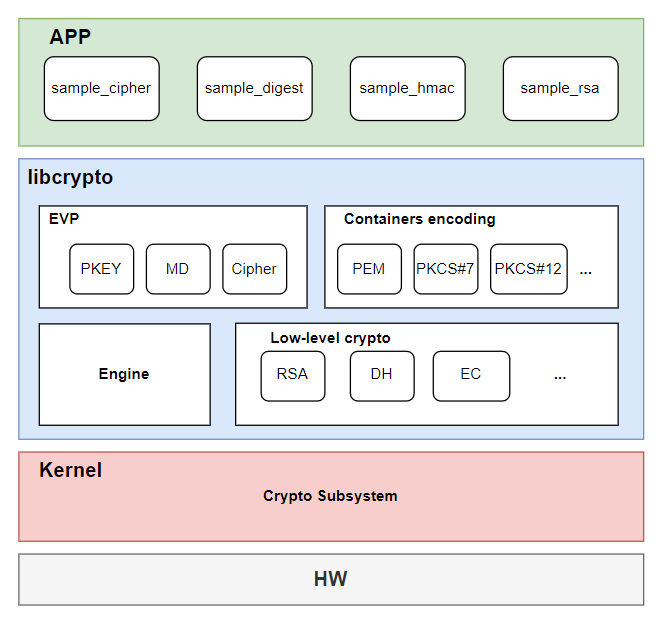
3.19.1.2. Code Location and Directory Structure
Code location:
app/samples/platform_samples/sample_cryptoDirectory structure
sample_crypto
├── sample_cipher
│   ├── Makefile
│   └── sample_cipher.c
├── sample_digest
│   ├── Makefile
│   └── sample_digest.c
├── sample_hmac
│   ├── Makefile
│   └── sample_hmac.c
└── sample_rsa
    ├── Makefile
    └── sample_rsa.c
3.19.1.3. API Process Description
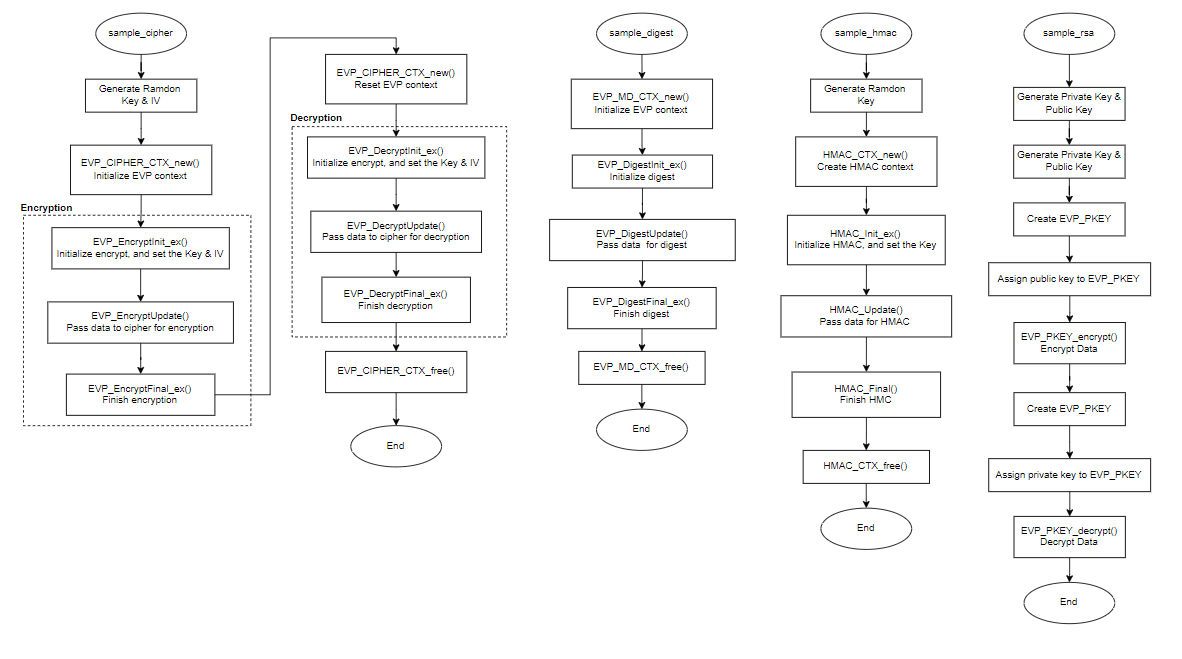
3.19.2. Compilation & Deployment
3.19.2.1. Compilation
Execute the make command in each subdirectory of sample_crypto to complete compilation. Taking sample_cipher as an example:
cd /app/samples/platform_samples/sample_cryto/sample_cipher
make
For detailed program compilation methods, please refer to the Compilation Methods section.
3.19.2.2. Deployment
After flashing the system software image, all sample programs of sample_crypto are located at /app/platform_samples/sample_crypto on the device.
3.19.3. Execution
3.19.3.1. sample_cipher Execution
sample_cipher Execution Method
Directly run the program
./sample_cipher -hto get help information
sample_cipher Parameter Options Description
Usage: sample_cipher [Options] [value]
Options:
  -s <cipher name>      Select Cipher Name
  -k <key size>         Key Size [64/128/192/256]
  -h                    Show this help message
Available Cipher:
        Cipher Name     Recommend Key Size
         1. aes_ecb     128/192/256-bit
         2. aes_cbc     128/192/256-bit
         3. aes_cfb     128/192/256-bit
         4. aes_ofb     128/192/256-bit
         5. aes_ctr     128/192/256-bit
         6. sm4_ecb     128/-bit
         7. sm4_cbc     128/-bit
         8. sm4_cfb     128/-bit
         9. sm4_ofb     128/-bit
         10. sm4_ctr    128/-bit
         11. des_ecb    64/-bit
         12. des_cbc    64/-bit
         13. des_ofb    64/-bit
Options:
-s <cipher name>: Select encryption algorithm.-k <key size>: Set key size.-h: Display help message.
Supported key sizes for each encryption algorithm are as follows:
| Encryption Algorithm | 64bit | 128bit | 192bit | 256bit |
|---|---|---|---|---|
| aes_ecb | × | ✔ | ✔ | ✔ |
| aes_cbc | × | ✔ | ✔ | ✔ |
| aes_cfb | × | ✔ | ✔ | ✔ |
| aes_ofb | × | ✔ | ✔ | ✔ |
| aes_ctr | × | ✔ | ✔ | ✔ |
| sm4_ecb | × | ✔ | × | × |
| sm4_cbc | × | ✔ | × | × |
| sm4_cfb | × | ✔ | × | × |
| sm4_ofb | × | ✔ | × | × |
| sm4_ctr | × | ✔ | × | × |
| des_ecb | ✔ | × | × | × |
| des_cbc | ✔ | × | × | × |
| des_ofb | ✔ | × | × | × |
sample_cipher Execution Results
Taking the AES algorithm as an example, using ECB mode with a 256-bit key length, perform encryption and decryption on the text string Test message for encryption, Cipher[aes_ecb], KeySize[256].
Execute the following command:
./sample_cipher -s aes_ecb -k 256
Output:
Encrypted text (hex): ffbc5dcf79a3e0bf45fb3f974983c3258f800e9eb65f78749710d35d9494dabc083f1481350d73fce81f5d513bb5e7da00c12f646cc2c3ae1a9604915ddad2ae
Decrypted text: Test message for encryption, Cipher[aes_ecb], KeySize[256]
It can be confirmed that the decrypted string matches the original text.
3.19.3.2. sample_digest Execution
sample_digest Execution Method
Directly run the program
./sample_digest -hto get help information
sample_digest Parameter Options Description
Usage: sample_digest [Options] [value]
Options:
  -s <hash name>      Select Hash Name
  -h                  Show this help message
Available Hash:
         1. md5
         2. sha1
         3. sha224
         4. sha256
         5. sha384
         6. sha512
         7. sha3-224
         8. sha3-256
         9. sha3-384
         10. sha3-512
Options:
-s <hash name>: Select hash algorithm.-h: Display help message.
Hash algorithms supported by sample_digest include:
MD5
SHA1
SHA-2: SHA-224 / 256 / 384 / 512
SHA-3: SHA3-224 / 256 / 384 / 512
sample_digest Execution Results
Taking SHA256 as an example, compute the hash of the text string Test message for digest [sha256].
Execute the following command:
./sample_digest -s sha256
Output:
plain_text:
Test message for digest [sha256]
[sha256] hash is:
ded9cd0a4ac6e11c38ab3ceb3cff7cff5d18a3bbc37b9fc578f96b3ee63df4b4
The hash value computed by sample_digest is ded9cd0a4ac6e11c38ab3ceb3cff7cff5d18a3bbc37b9fc578f96b3ee63df4b4.
Compare with the system command sha256sum:
echo -n "Test message for digest [sha256]" | sha256sum
ded9cd0a4ac6e11c38ab3ceb3cff7cff5d18a3bbc37b9fc578f96b3ee63df4b4
It can be confirmed that the hash value computed by sample_digest matches the system command output.
3.19.3.3. sample_hmac Execution
sample_hmac Execution Method
Directly run the program
./sample_hmac -hto get help information
sample_hmac Parameter Options Description
Usage: sample_hmac [Options] [value]
Options:
  -s <hash name>  Select hash Name
  -k <key size>   Key Size
  -h              Show this help message
Options:
-s <hash name>: Select hash algorithm.-k <key size>: Configure key length.-h: Display help message.
Note: HMAC keys can be of any length, but it is recommended that the key length matches the selected hash algorithm.
Hash algorithms supported by sample_hmac and their recommended key lengths are as follows:
Available Hash:
        Hash Name        Recommend Key Size
         1. md5          128-bits
         2. sha1         160-bits
         3. sha224       224-bits
         4. sha256       256-bits
         5. sha384       384-bits
         6. sha512       512-bits
         7. sha3-224     224-bits
         8. sha3-256     256-bits
         9. sha3-384     384-bits
         10. sha3-512    512-bits
sample_hmac Execution Results
Using SHA256 with a 256-bit key length, compute the HMAC of the text string Test message for Hmac: Hash[sha256] Key[256].
Execute the following command:
./sample_hmac -s sha256 -k 256
Output:
plain_text:
Test message for Hmac: Hash[sha256] Key[256]

Key is:
37099184641824357814880241575040

HMAC is:
8c5b046e961c4dfaea07c60293ebd36b9cea95cfba7e31c02c583a5cdb2303e2
The HMAC computed by sample_hmac is 8c5b046e961c4dfaea07c60293ebd36b9cea95cfba7e31c02c583a5cdb2303e2.
Use the openssl command with the same KEY and message to verify the HMAC:
Note: sample_hmac generates a random number based on key size as the key each time; copy the key string as the openssl command parameter
echo -n "Test message for Hmac: Hash[sha256] Key[256]" \
| openssl dgst -sha256 -hmac "37099184641824357814880241575040"
Output: 8c5b046e961c4dfaea07c60293ebd36b9cea95cfba7e31c02c583a5cdb2303e2
It can be confirmed that the HMAC value computed by sample_hmac matches the system command output.
3.19.3.4. sample_rsa Execution
sample_rsa Execution Method
Directly run the program
./sample_cipher -hto get help information
sample_rsa Parameter Options Description
Usage: sample_rsa [Options] [value]
Options:
  -k <key size>     Key Size [1024/2048/3072/4096/8192]
  -h                Show this help message
Options:
-k <key size>: Set key length, supports 1024 / 2048 / 3072 / 4096 / 8192-h: Display help message.
sample_rsa Execution Results
Using RSA-2048 as an example, encrypt the text string The test message for RSA-2048 encryption! with the private key and decrypt with the public key.
Execute the following command:
./sample_rsa -k 2048
-----BEGIN RSA PRIVATE KEY-----
MIIEpQIBAAKCAQEA1iFUncTYJEnDxdpzcj+4ZYyj2jpu7GgE0/3Z9r91H2y54nju
GyyeLV1zAaekxpHcvbxkdqozb5sU8St2jAaj6M7413dEQstO+DNK1U4y7KTeC67g
eJ11Qmya0bpvKaWmrA8/9xi0TLJs/P0MzVMgHpZNSjn2EeKuMRT+operzJYfqvFe
VoX+9iZjzaiCSO1Ely4jP77nuMlGnrUUAfMT79WveEOO6IErxyvpic/RiBDnWmn6
IjWjFGxVsqMqDfWHKI4ceGPAESfXp6rNJ134WcJjZT6CW1cWT2UcmIHgFJTgGo+R
TggPM2yloancHxSiK1D8gcuugRspIchEKoUbrwIDAQABAoIBAQCaYKNRr4Yo+2mC
rpEG8Huv8up6viAUnpXEhMLtC3GUe120snzv6IYNrM7qhYPdiXG89SL1DpZQw10g
1rX8FBl+EiIDrb/v7AX+GXS9PkimpeJUR/sb2mGcxxIDXMciHoSAjeoO6qeqmATN
jF77dQ+2HaSRfCI1GNl/F2TRskmxD8RN6u/sX5MqvdLU5z7mV2Lzn2XsryrRyc5S
+6AfVy554IYdyOsW56uiTyXfhEDF/OFCiNIHR7nVDD4ziW71RjydEazosiFnwqWB
3igfsCll6hN5JY0ZorRxEDozB0UeP5GFfpAJ1UvnFPpunyxK8cEAk8K2y9v1TwJm
fAyMxcChAoGBAPsZ6CTvlOhKrMwRl/ZX4exS2CezDIEoNFoWYQ9MuXC5mYe3QHFJ
SL2ptv2WcMUEX7dlx278kCXQtRyqOMIqopRSxhTh62+i6PevxUokYu8hVYfeMbIq
PoSqNwmLJvs7jSxC6lwi2s+S4PU2tQyNgRnD86DMwrBXoUcs23XTyN9fAoGBANpO
xteskS4FJ82m00N3QS7S5ScuX2MbtxstmjFvPkbEkY40BabtspKtMd3Bzkfu95Ex
K8UuCPWtfM8RGPEitDWmRLjVaA3MpRuNykqProryFxpkgQvnWIYYV/R3MJPnZo2X
F/XSzj+6X9k1G58EMi+gV75V12LQL5i6d3dIHDWxAoGBAIlKw/QWDsvnsI0vfXAS
4xMsxMUID+k6i01KeS09XRM2V6yt1I1cbWpONiB3Nhdy6cbD3oRfkY0rjSssIzZ+
yz/f9jAKyojSgSCUOYHtXS60gih0o6VvlZlB3C/apqitCeZOfAd+gzcFbvyEOf+w
CwuEaVvdOQHkF+lrrF7DOkxvAoGBAMH23ltAO1ntQLlLMUgvTB4DSZEvdZcESAOA
2BB2K5oLCtyTQjZX2aLS+YxzpwlovFQnoSE3zsQiWdNM+KE/WWiVi1fCXQptuoEp
0QPAd6+Ce556j+H4skGqnXNa9zFil07UYXiLza73tDO0KQ93VfPU/kDh2lY0bSXA
/2ZfDplxAoGAYVURUd4GqYuGo1xJ4GQc5vNgM1BVMlGLtFIE0S7IcuqjDoQrNArz
giOZQm0IdFS6Na9HcZJuQE2TZEXrFgPbRP7k5Ewih2LrallTO2To+Tua4gGNmRvE
0EupPJH3VxTTKbP0Qha/Y9g9NFQk0FR0f6AWnzMGvgzYsfj88lXujes=
-----END RSA PRIVATE KEY-----
-----BEGIN PUBLIC KEY-----
MIIBIjANBgkqhkiG9w0BAQEFAAOCAQ8AMIIBCgKCAQEA1iFUncTYJEnDxdpzcj+4
ZYyj2jpu7GgE0/3Z9r91H2y54njuGyyeLV1zAaekxpHcvbxkdqozb5sU8St2jAaj
6M7413dEQstO+DNK1U4y7KTeC67geJ11Qmya0bpvKaWmrA8/9xi0TLJs/P0MzVMg
HpZNSjn2EeKuMRT+operzJYfqvFeVoX+9iZjzaiCSO1Ely4jP77nuMlGnrUUAfMT
79WveEOO6IErxyvpic/RiBDnWmn6IjWjFGxVsqMqDfWHKI4ceGPAESfXp6rNJ134
WcJjZT6CW1cWT2UcmIHgFJTgGo+RTggPM2yloancHxSiK1D8gcuugRspIchEKoUb
rwIDAQAB
-----END PUBLIC KEY-----

Encrypted text:
0c2f5795bfab85e0cccc32f729ab6050a079212eb260b88257bbbaaf3528804f69e657d132380edcf4dc28ee683ba41013b6a0404afdba4268c3bf9784c27567cd2f03ac6f2f92ac7663680fc405cc4e60aacc35b9ec33ef02fa0d10a9b28c4b2214a78807a2f234fd764d153e82eddf42fea42799e6632f7cda8678f6e288c1e711b7d94ea092736d8fdfd2b8b771ad8f8a9567

Decrypted text: The test message for RSA-2048 encryption!
It can be confirmed that the decrypted string matches the original text.
3.19.4. Common Issues
3.19.4.1. What are the differences when using different key lengths in HMAC?
HMAC key length can be flexibly chosen. When the key length does not match the hash function’s block length, the following processing is applied:
Key length smaller than hash function block length: For example, using SHA-256 with a 512-bit key, the algorithm internally pads zeros at the end of the key to reach the block length.
Key length larger than hash function block length: For example, using SHA-256 with a 128-bit key, the algorithm internally hashes the key and uses the hash result as the actual key.
Generally, for security reasons, it is recommended that the key length equals the output length of the hash function.